The new generation of Thunderbolt 5 interface standards, i.e. Thunder 5, achieved a huge leap in transmission speed and connection capability, and also demonstrated a new generation of thunder-based laptops, extension-port prototypes. Here, let us look at what changes have been brought about by Thunder5 and how we can change the way we work, live and entertain.

Thunderstorm technology was born in 2011 and a single interface was achieved for the simultaneous transmission of video and data, with 10 Gbps in bandwidth, doubling to 20 Gbps in the second generation in 2013.
The third generation in 2015 not only doubled its bandwidth to 40 Gbps, introducing electricity, but also introduced a standard USB-C interface, opening a new era.
In 2019, the 10 generations of Intel Wisdoms formed into thunderstorms 3, making it easier to deploy and universal, and generously contributed free of charge to USB-IF, resulting in the birth of a new USB4, also with a bandwidth of 40 Gbps, which is now spreading rapidly.
In 2020, thunderstorm 4 was born, and the bandwidth has not changed, but there has been a marked increase in all experiences, and from 11 generations of idiosyncrasies, it has been used extensively for many devices such as notebooks, monitors, hubs, extension docks, etc.
At present, lightning technology has become widely available, with 90 per cent of the 13 cool and wise processors having thunder4 and all Evo, Evo Enterprise certified notebooks having thunder4, Windows, Linux, MacOS, CholomeOS, all supporting thunder4.
The PC computer product based on lightning 3/4 has already exceeded 1,500 pieces and spare parts over 1,000.

Thunder 3/4 and USB4 are largely connected, with interfaces in the same shape and bandwidth, and with access to HDMI and DP, what difference does it make? What's the advantage of lightning?
Indeed, USB4 and Thunder4 do achieve a large number of the same technical characteristics, but most of them are optional for USB4 and support depends on the choice of the equipment manufacturer, while thunder4 is mandatory, which means that advanced connectivity experiences can be enjoyed by using the Thunder4 interface.
These include mandatory detection and certification, 40 Gbps transmission bandwidth, 40 Gbps data lines of 2 m length, up to 4 interfaces, at least 15 W charge power, double 4K60 monitors, at least one interface to support power supply, system sleep awakening, Intel VT-d DMA protection mechanism, etc.
At the same time, thanks to the advantages of Intel systematization and platformization, the Thunder 4 interface is also unique in terms of the original integration of CPU processors and operating systems, platform validation, lightning authentication, Evo/vPro user experience, all of which are beyond the reach of USB4.
Intel Client Calculating Enterprise Product Manager Bluewood? It was also stressed that the two main technical standards, Thunder and USB, were not competitive and that there would be no replacement, since the two were focused on different directions: Intel focused on data centres, the PC area and related products, and USB covered a wider range of consumer electronics and smart equipment.
In fact, Intel is one of the key members of the USB Association, and the two sides have been cooperating to advance technology and products, such as Intel, which contributed lightning 3 technology to the USB Association without charge.

Next, let's look at the specific changes in lightning 5.
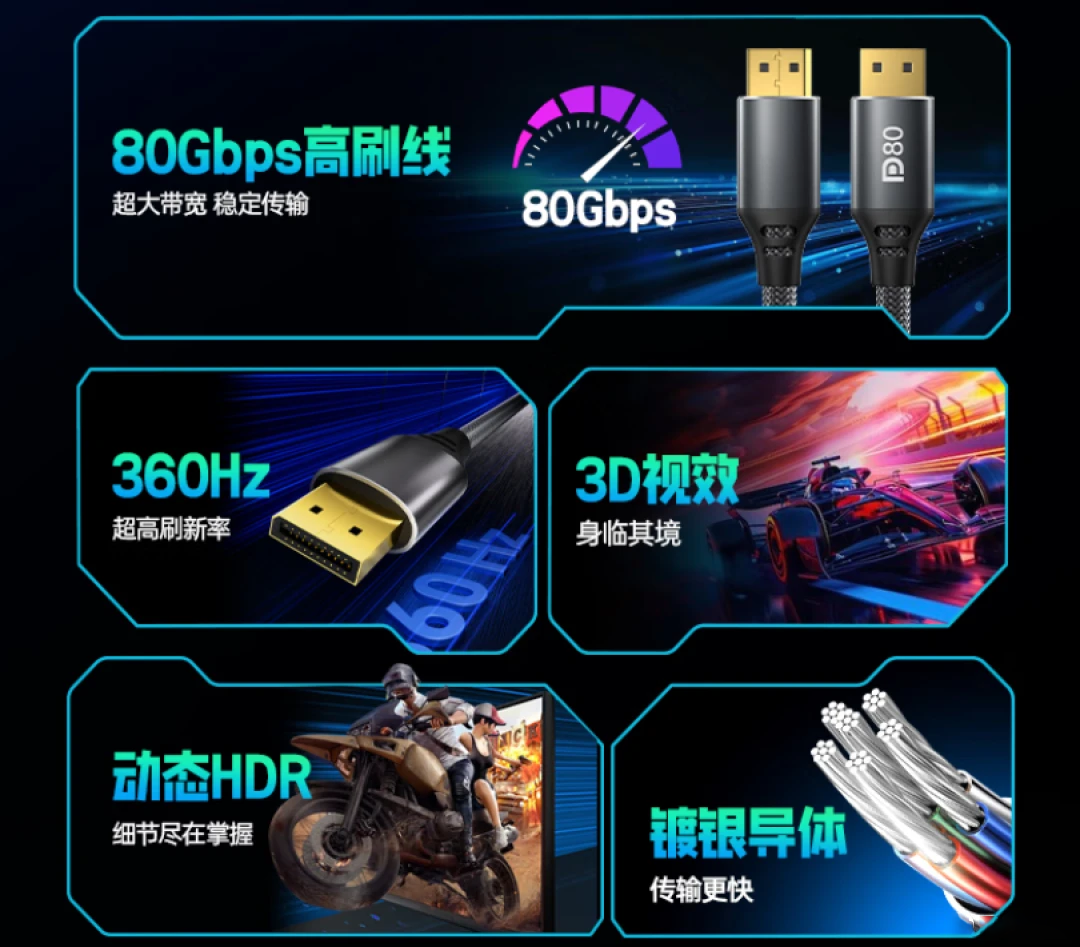
First, with regard to the core bandwidth, lightning 5 is based on PCIe 4.0 x 4 each providing two 40-Gbps channels, so that even if data were transmitted and received simultaneously, it would be possible to achieve 80-Gbps one-way, twice as high as lightning 4, while the four two-way channels combined are 160-Gbps.
The bandwidth of Thunder 5 is no longer fixed, but is adjusted flexibly for usage, for example, when it requires a large volume of transmission to receive less, and three corridors can be used for transmission, at which point the bandwidth can be increased to 120 Gbps.
This is half more than DP 2.1 80 Gbps, 1.5 times more than HDMI 2.1 48 Gbps and two times more than USB4 40 Gbps.

When it comes to USB4, it is necessary to shed some light on the confusion of the USB-IF organization, both in terms of labelling norms and naming rules.
We usually say that the USB4 theoretical bandwidth is 40 Gbps, but it's also an option, and that actually goes to 20 Gbps and goes to USB4, even if it's actually the USB 3.2 Gen2x2.
A full year ago, in September 2022, USB-IF had another USB4 2.0 claiming that the maximum bandwidth had been raised to 80 Gbps, that it had caught lightning, and that it was equally open for expansion to 120 Gbps.
However, the USB-IF Association has not been mandatory for these bandwidth specifications and supports the choice of a complete view of the equipment manufacturer, so that it is easy to cause confusion, unlike lightning, which must meet certain minimum standards.
To ensure signal stability and data integrity under high-speed transmissions, Thunder Force 5 introduced PAM-3 pulse amplitudes, allowing more data to be processed during each clock cycle, thereby achieving a more stable bandwidth.
At the same time, existing data lines, switches, PCB circuit boards, etc. are compatible and can continue to be used.
USB4 2.0 was also introduced to PAM-3, while the next generation of PCIe 6.0 was upgraded to a higher PAM-4 and corrected in the context of ECC.
Intel explained that it was mainly PAM-3 that was technically adequate, cost-controlled and compatible with existing components, and that a combination of considerations was the most appropriate and PAM-4 had a higher technical threshold.
More abundant bandwidth gives lightning five more application space to support higher specifications of video transmission, data transmission and equipment connectivity.
In video, for example, lightning 4 can only support two 4K60 monitors, with no balance between resolution and refreshing rates, and one has to compromise, but lightning 5 is much more flexible, not only to support a set of data lines linking three 4K144 or two 6K monitors, but game players can achieve a maximum of 540Hz and creators can connect to multiple 8K monitors.
In terms of data, the bandwidth of 80 Gbps, or even 120 Gbps, can easily connect more and more performing SSDs, external graphic cards, etc., and, as noted above, can be configured flexibly and more easily used.
For charging, the minimum power was raised from 100 W to 140 W, while the maximum power was increased significantly from 140 W to 240 W, so that a single data line would easily drive more equipment and make the desktop cleaner.
Displays a connection demonstration: A lightning 5 data line connects multiple high-resolution, up-to-date monitors.
Storage connection demonstration: The external SSD can run at a higher speed, e.g. it is read more than 6.2 GB/s, it is written close to 5.4 GB/s, and it has reached the primary level of the high PCI 4.0 x 4 SSD.
Thunderline 5 also has a very functional “thunderbolt network”, which allows point-to-point connections between two PCs using a lightning data line, and a qualitative leap in transmission speed as the bandwidth doubles.
This function allows data and file transmissions between different PCs to be considerably simplified and speeded up, and no longer needs to be done by using devices such as disks, mobile hard drives, etc.
As far as data lines are concerned, lightning5 can continue to use the current one-metre-long passive thunder-4 data line, while active data lines of two metres or more need to be redeveloped.
Of course, the consistent strong compatibility of lightning is also essential. Thunder5 not only allows for downward compatibility of lightning 4 and 3 but also for major transmission standards such as USB4 series, USB 3.x series, DP 2.1, and also for the export of HDMI through the extension dock.
In other words, with a lightning-5 interface, protocols can be eaten without the need for different data lines.
There is, of course, a very real problem here, which is that many notebooks, main boards, provide only one or two lightning/USB-C interfaces, which can easily be insufficient and require additional building purchases to increase costs and complexity.
Intel explained that a growing number of clients and consumers wanted medium- and high-end notebooks to be lighter and simpler, that access to HDMI and DP interfaces in daily life was not much, and that lightning5 could support four interfaces, fully equipped to meet the day-to-day needs of the vast majority of users, even two to three.
Of course, this is also a paradoxical trade-off, and if there is a real need to use multiple devices at the same time, a simple building may have to be bought.

The above is a prototype of a thunder 5 extension station with a surface clearly marked 80G/120G representing bandwidth.
Lightning 5 interfaces have two, charged power supporting 140 W and 60 W, of which 60 W is earmarked for the expansion, although this can be customized flexibly by the manufacturer.
Lightning 5 supports up to four interfaces, and the current standard design for power supply is for PC, allowing high power, three for downwards, and the standard is 15W.
Even the total power of the four interfaces is not limited to 240 W, and it is not impossible for each interface to do 140 W, but it has to be replaced by a power adapter and the problem of dissipation.
While thunderstorm technology itself is becoming more powerful, expansional parts are becoming more abundant and can be used for work, games and scenes, such as expansion sites, external display cards, external storage, turnovers, displaying support frames, etc.
It is worth mentioning that thunderstorm 5 can also be connected to the AI accelerator to meet the growing demand for al-calculation.
The above is a summary of the new characteristics of lightning, and a comparison with lightning, USB4/3, DP.
As can be seen, Thunder5 outnumbers USB, DP in transmission bandwidth, power supply, connection reliability and flexibility.
Lightning 5 will use a new marking image, whether of the manufacturer ' s promotional material or of the electric platform, which, if seen in a blue-floor white lightning shape, will be known as a Thunder 5 standard device.
In addition, there will be a word “5” in the head of the lightning 5 data line to distinguish.
However, interfaces and adjacent icons do not specifically indicate thunder, and in fact have not been marked for generations.

Lightning 5 will first be pushed to the market through an independent controller code-named Barlow Ridge, and it is expected that computers, accessories and equipment supporting Thunder 5 will be available in 2024.
Intel will also provide global developers with technical information and resources for thunder power5 in the fourth quarter of this year to facilitate the adaptation of new products and applications.
However, Thunder 5 does not directly replace Thunder 4 but coexists for a period of time, with thunder 5 for high-end creators, game players and thunder 4 for mainstream businesses and consumers.

Unless otherwise noted, all articles on this site are original content by JCE Cable Co., Ltd.
If you wish to republish this article, please attribute the source: https://www.jcecable.com/thunderbolt-5-120gbps-240w-vs-usb4-v2/