🌐 Introduction: From "Connector" to "Smart Channel"
Since its introduction in 2002, HDMI has completed the transformation from HD transmission interface to immersive digital life hub .HDMI 2.2 released in 2025 not only doubles the bandwidth to 96 Gbps, but also introduces intelligent synchronization mechanisms at the protocol level - marking the official entry of HDMI into a new era of high-bandwidth, low-latency, adaptive .

This article will disassemble the core technology system of HDMI 2.2 from the perspective of communication protocol :
- ✅ physical layer and bandwidth evolution (FRL + architecture)
- ✅ protocol stack layered model (video/audio/control/security)
- x✅ Device handshake and capability negotiation process (EDID + SCDC + lip)
- ✅ New Core Feature: Latency Indication Protocol (lip)
- ✅ scenarios and future ecological outlook
📈 First, the bandwidth revolution: how to achieve 96 Gbps?
🔁 From TMDS to FRL: A Fundamental Leap in Architecture
| HDMI Version | Transmission Technology | Maximum Bandwidth | Channel Structure | Encoding Method | ||
|---|---|---|---|---|---|---|
| 1.x | TMDS | 10.2 Gbps | 3 Data + 1 Clock: | 8b/10b; | ||
| 2.0; | TMDS; | 18 Gbps; | same as above; | same as above; | ||
| 2.1; | FRL; | 48 Gbps; | 4; Differential data channel: | 16b/18b or none Gbps | 4 × 24 Gbps/lane | Optional DSC 1.2a |
💡 FRL (Fixed Rate Link) Eliminates the independent clock line and adopts embedded clock recovery technology, significantly improving spectral efficiency and anti-interference capability.
Actual meaning of🎯 96 Gbps
- Uncompressed video support
8K @ 60Hz, 4: 4: 4, 12-bit4K @ 240Hz, 4: 4: 4, 10/12-bit
- DSC Compression Extension (Display Stream Compression)
12K @ 120Hz(4: 2: 2/4: 2: 0)16K @ 60Hz(theoretical limit)
- Redundant bandwidth reservation : Provides "bandwidth margin of safety" for future scenarios such as AR/VR, spatial computing, multi-stream multiplexing.
🧱 II. Protocol stack architecture: hierarchical model of HDMI 2.2
HDMI 2.2 is not a single protocol, but an multi-layer collaborative intelligent communication system :
┌───────────────────────────────┐
│        Application Layer (Video/Audio)    │ ← HDR, VRR, ALLM, QFT├───────────────────────────────┤
│        InfoFrame Layer           │
│   ├─ AVI InfoFrame            │ ← resolution, color space, dynamic metadata
│   ├─ Audio InfoFrame          │
│   └─ Vendor-Specific IF       │ ← Dolby Vision, HDR10 +, etc.
├───────────────────────────────┤
│        Lip Protocol           │ ← ⭐ Added: Delay Indication Protocol
├───────────────────────────────┤
│        HDCP 2.3/3 .0         │ ← Content Protection Encryption (AES-128/256)
├───────────────────────────────┤
│        Physical Layer                 │
│   ├─ FRL (96 Gbps)            │ ← four-channel differential signal
│   └─ eARC                     │ ← standalone audio backhaul (based on S/PDIF extension)
└───────────────────────────────┘
🔔 eARC (Enhanced Audio Return Channel) Although physically separated from the main video channel, it achieves logical coordination through CEC bus , and supports lossless audio (such as Dolby TrueHD, DTS: X) backhaul to the sound system.
🤝 Phase 1: Physical Connection Detection (HPD)
- Sink Pull up the Hot Plug Detect (HPD) signal to notify the Source device that it is plugged in.
Phase 2: EDID read
- Source Reads Sink's Extended Display Identification Data via DDC (I ² C bus) for its support:
- resolution & refresh rate
- Color Format (RGB/YCbCr)
- HDR capability (HDR10, HLG, Dolby Vision)
Phase 3: SCDC Dynamic Negotiation
- Status and Control Data Channel (HDMI 2.0 introduced) for real-time switching:
- FRL rate gear (6/8/10/12/24 Gbps per lane)
- HDCP version
- VRR (variable refresh rate) support status
- HDMI2.2 Extend SCDC to support lip parameter passing.
Phase 4: lip initialization (new in⭐ HDMI 2.2)
- Multi-hop systems (e.g. game console → AV amplifier → TV), where each node reports its own processing delay (in ms) via LIP InfoFrame (Type =
0x87).
the - system automatically calculates the total delay and adjusts the audio and video output timing to achieve end-to-end lip synchronization .
x📌 Example : TV video processing = 30ms → Source sends audio 75ms in advance if Soundbar delay = 45ms.
⚡ IV. New Core Protocol: Delay Indication Protocol (lip)
🎯 Design Target
- resolution & refresh rate
- Color Format (RGB/YCbCr)
- HDR capability (HDR10, HLG, Dolby Vision)
- FRL rate gear (6/8/10/12/24 Gbps per lane)
- HDCP version
- VRR (variable refresh rate) support status
0x87). x📌 Example : TV video processing = 30ms → Source sends audio 75ms in advance if Soundbar delay = 45ms.
Resolves audio-visual asynchrony in multi-device link (Multi-hop) with traditional HDMI.
🔧 Working mechanism
- Each LIP-capable device broadcasts its input/→output delay value ;
- Passed using dedicated InfoFrame Type 0x87;
- supports dynamic updates (if switching audio modes causes delay changes);
- Backward compatible : old devices can safely ignore lip frames.
✅ Technical Advantage
- Sync Accuracy ± 1ms
- does not require the user to manually set the Audio Delay Compensation
- is critical for real-time interaction scenarios such as cloud gaming, livestreaming, teleconferencing, and VR social x
🚀 v. Application scenarios and future trends
| realm | scenario |
|---|---|
| home entertainment | 8K HDR movie + Dolby Atmos + Auto Lip Sync; VRR + ALLM gaming experience <10ms delay |
| AR/VR | high PPD (>30) headset requires >50Gbps bandwidth; supports eye tracking feedback and asynchronous time distortion (ATW) |
| car display | dashboard + central control + rear row entertainment multi-screen linkage; eARC achieves independent audio partition |
| content ecology | xph Netflix/YouTube test 8K @ 60 HDR streaming; Unreal 6 engine native support 120Hz + output |
⚠️ VI. Challenges and Prospects
Despite technological advances, HDMI 2.2 still faces real-world challenges:
| Challenge | Description |
|---|---|
| Cable Cost High | Ultra96 Certification Lines Need Precision Manufacturing, 3m + Significant Price Increase |
| Chip Support Lagger | As of 2025Q4, only a few SoCs such as Sony CXD, Amlogic C3 support 96Gbps FRL |
| xph_x Content Ecosystem to be matured | xph_x12K Content, almost blank at 8KHz, near-term strength | xph_x
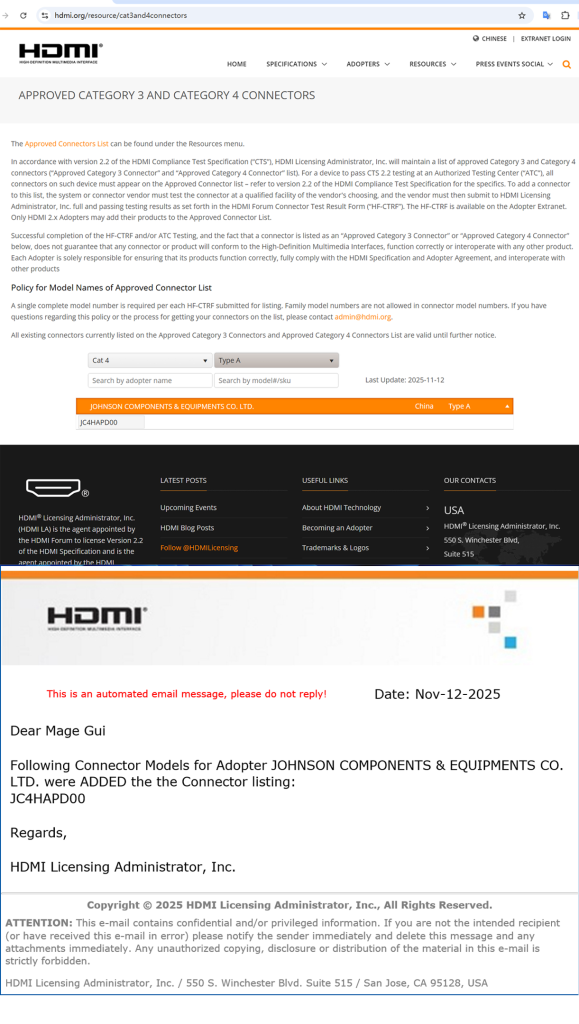
✅ Positive signals : Yongtai Electronics and other manufacturers have mass-produced Ultra96 certified cables, HDMI Forum strengthens the anti-counterfeiting and certification system, and it is expected that 2027-2028 will become the mainstream high-end interface standard.
🌅 Conclusion
HDMI 2.2 is no longer just “one wire”, but a set of smart communication protocol stacks for the immersive digital life of the future.It passes:
- 96 Gbps FRL + physical layer
- LIP Smart Sync Protocol
- eARC hi-fi audio backhaul
- Dynamic Metadata Framework
builds an high-bandwidth, low-latency, adaptive audio and video delivery ecosystem.
In the AI, metaverse, and spatial computing accelerated landing today, HDMI 2.2 is becoming the key to connecting virtual and reality "synapses" .
📚 references
- HDMI Specification 2.2, HDMI Forum, July 2025
- HDMI 2.2 Compliance Test Specification (CTS) v1.0
- “Latency Indication Protocol Technical White Paper”, HDMI LA, 2025
- IEEE Transactions on Consumer Electronics, “FRL Signal Integrity at 24 Gbps/lane” , Nov2025

Unless otherwise noted, all articles on this site are original content by JCE Cable Co., Ltd.
If you wish to republish this article, please attribute the source: https://www.jcecable.com/hdmi-2-2-protocol-deep-dive/