HDMI 2.2 raises the maximum data rate from 48Gbps to 96Gbps — enough for 16K@60Hz, 4K@240Hz and uncompressed high-frame-rate gaming. But the specification only defines what the interface can do. Whether a passive copper cable actually delivers 96Gbps at your length depends on physics: attenuation, impedance control and shielding. This article explains what changes at 96Gbps, why wire gauge (AWG) and length become decisive, and how to choose a construction that holds up.
Why 96Gbps is harder on cables than 48Gbps
HDMI 2.1 (FRL) transmits up to 48Gbps across four lanes. HDMI 2.2 doubles the per-lane rate, which means the cable must pass roughly twice the frequency content. High-frequency signals attenuate faster in copper: the longer the cable, the more the signal's higher harmonics are eaten before they reach the display. The visible symptoms are familiar — dropouts at high refresh rates, sparkle/noise on screen, or the link silently renegotiating to a lower rate.
This is why the industry's certification programs test cables by length and construction, not just by connector. A 1m cable and a 5m cable with the same connector shell are not the same product.
AWG: the single biggest lever
American Wire Gauge describes conductor thickness — lower numbers mean thicker conductors and lower attenuation. For passive HDMI 2.2 cables, practical ranges look like this:
- 30AWG — slim and flexible; carries the full 96Gbps up to about 2 m. Ideal for docks, consoles and in-room connections where bend radius matters.
- 28AWG — a balanced gauge for mid-length runs around 3 m.
- 24AWG — heavy-gauge construction required to hold 96Gbps at 4–5 m, at the cost of a stiffer, thicker cable.
Beyond roughly 5 m, a passive copper cable at 96Gbps becomes impractical: the conductor required would be unwieldy and expensive. That is the point where active or optical solutions enter the conversation — a trade-off between reach, flexibility and budget.
What certification actually proves
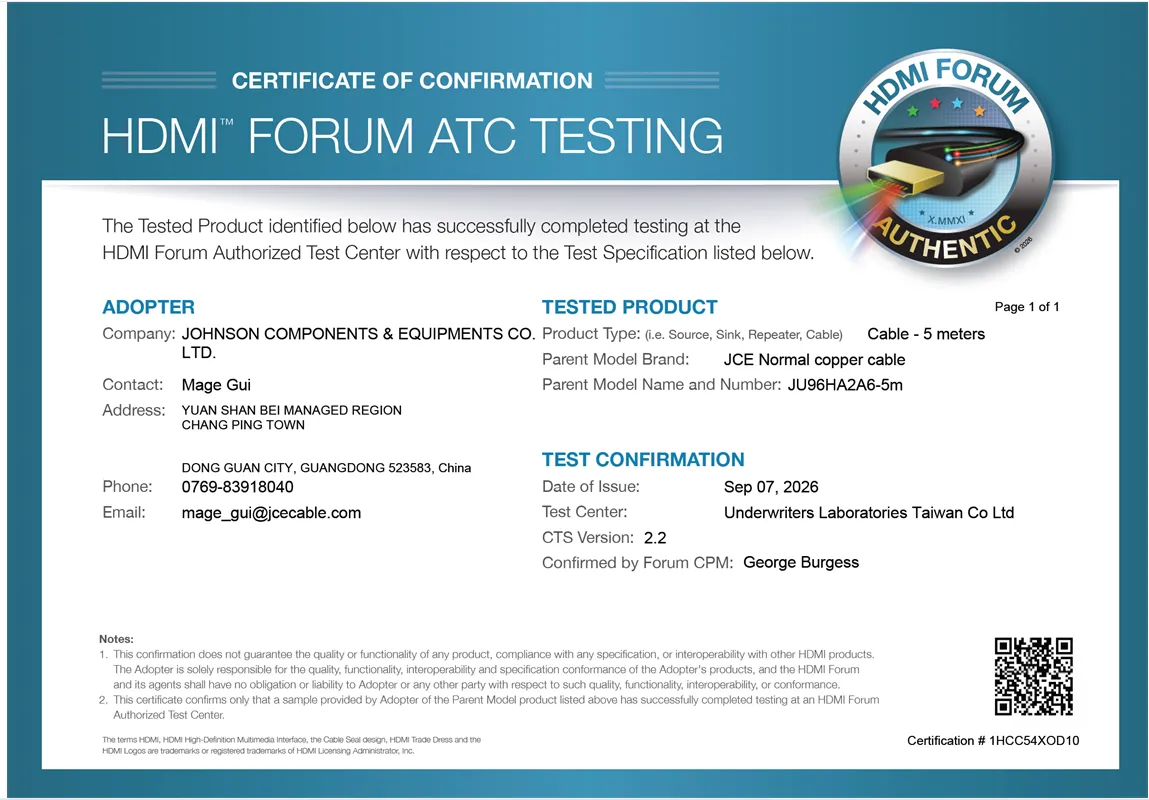
An HDMI Forum Authorized Test Center (ATC) certifies a specific parent model at a specific length against the compliance test specification. A certificate for a 2 m cable says nothing about a 5 m cable — which is why JCE certifies each length separately. Our current HDMI 2.2 certifications, verified at Granite River Labs (Dongguan) against CTS 2.2, cover seven parent models:
- JU96HA2A3 series (30AWG) — 0.5 m, 1 m, 1.5 m, 2 m
- JU96HA2A1-3m (28AWG) — 3 m
- JU96HA2A6 series (24AWG) — 4 m, 5 m
Certificates are available on request, and the full model table lives on our HDMI 2.2 Ultra96 product page.
Construction details that matter at 96Gbps
- Conductor: oxygen-free copper, with gauge chosen per length (see above).
- Shielding: a combination of braid and aluminium foil to control both low- and high-frequency interference; alloy EMI-shielded connector housings reduce radiated coupling at the termination, where impedance discontinuities are largest.
- Impedance control: consistent 100-ohm differential impedance along the cable and through the overmold keeps return loss in spec.
Practical guidance for buyers
- Match gauge to length. Don't buy a slim 30AWG cable for a 5 m run and expect 4K@240Hz — the physics won't cooperate.
- Ask for per-length certification. If a supplier claims 96Gbps at 10 m in a passive cable, ask for the ATC certificate for that exact model and length.
- Consider the install. Slim 30AWG is easier to route behind wall-mounted displays; 24AWG earns its bulk only when you need the reach.
- Longer runs: evaluate active/optical options at 48Gbps (certified AOC) before committing to long passive runs at 96Gbps.
How JCE can help
JCE Co., Ltd. manufactures high-speed HDMI, DisplayPort, USB4/USB-C and Ethernet cable assemblies in Dongguan, China, with in-house signal-integrity testing (TDR, eye diagram, insertion/return loss) and HDMI Forum ATC certification support. For OEM/ODM programs we customize length, gauge, jacket and packaging — and we will tell you honestly when a requested length/gauge combination won't pass 96Gbps, before you spend tooling money.

Unless otherwise noted, all articles on this site are original content by JCE Co., Ltd.
If you wish to republish this article, please attribute the source: https://www.jcecable.com/hdmi-2-2-96gbps-awg-length-signal-integrity/